
'/%3E%3C/svg%3E)



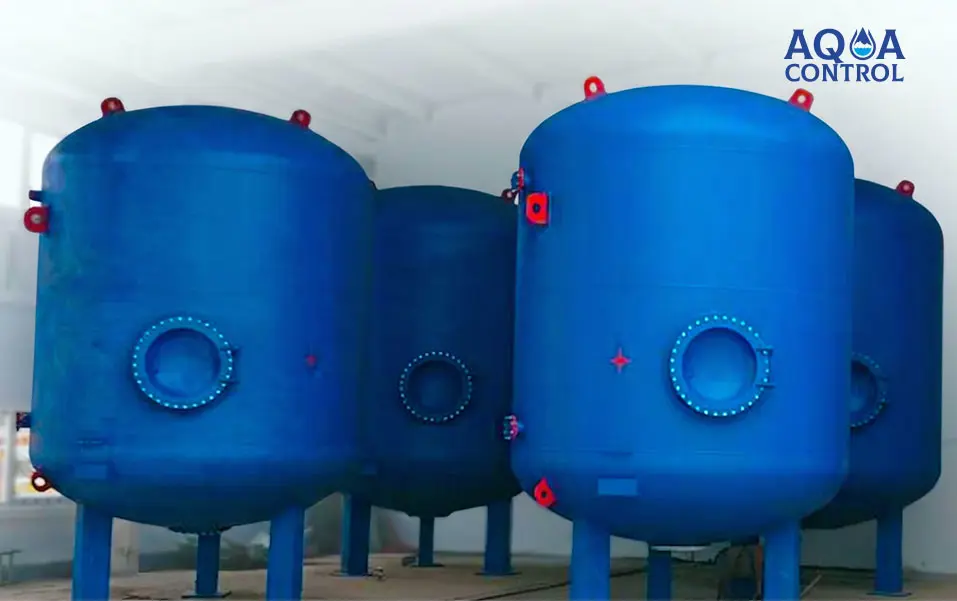
Product Review:
Silica sand filter is designed to remove suspended particles, solid impurities and other contaminants from water, and reduce its turbidity down to a level corresponding to water quality requirements for equipment downstream. Filter is designed to restore its ability to retain contaminants by periodic cleaning. It consists of a main casing, filter media made from silica sand, a water cover, external pipes and a sampling device.
Equipment features:
The silica sand filter uses purified silica sand as the filter media, and effectively removes impurities from the water. It is characterized by low hydraulic resistance, possessing large specific surface area, high resistance to acid and high resistance to pollution. Filter’s unique advantage is its adaptable operation due to optimized design of the filter media and the filter itself. The filter media is highly adaptable to source water concentration and operating conditions, including pretreatment. When filtering, the filter automatically forms a structure with a top sparse and bottom dense layer, to maintain water quality in various conditions. During backwashing, the filter media is thoroughly dispersed to boost the purification efficiency.
The silica sand filter can effectively remove suspended solids that are suspended in water and make a significant impact on the removal of colloids, iron, organic substances, pesticides, manganese, bacteria, viruses and other pollutants. It has high filtration rate, precision, and high capacity and strong ability to retain pollutants.
The flotation tank design takes into account the hydraulic residence time of the effluent to ensure complete impurity extraction. The high-precision aeration system reduces energy consumption. Our technological solutions for automatic dosing of coagulants before flotation guarantee water clarity in accordance with GAK standards.
 Address
Uzbekistan, Tashkent region, Bostanlyk district, Yoshlik MFY, Farogat str., 20A
 Phone numbers
 E-mail
info@asmex.uz
 Linkedin
 Instagram
 Telegram
 Download the catalog