
'/%3E%3C/svg%3E)



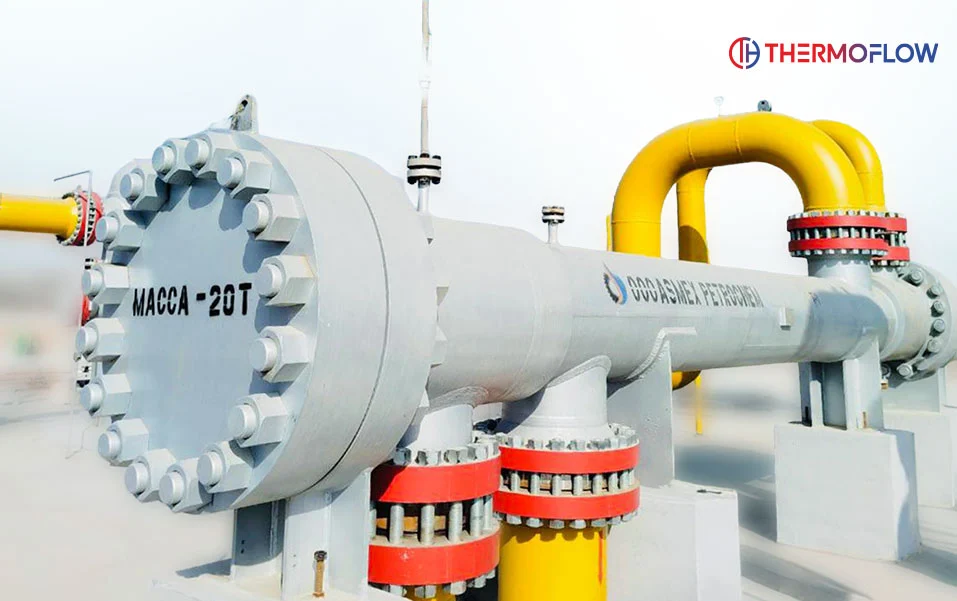
Industrial heat exchangers are technical devices that exchange heat between two media at different temperatures. Shell-and-tube equipment refers to devices in which the heat transfer surface between the two flows is formed by tubes enclosed in a shell, and heat transfer occurs through the surface of these tubes. Shell-and-tube coolers are water heat exchangers for cooling various petroleum products. They have a similar design to shell-and-tube coolers. The only difference is that recirculated water is used as the cooling fluid. Heat exchangers – equipment for various purposes, with designs ranging from shell-and-tube to plate-and-fin, are used in refrigeration engineering. Devices with phase transition of heat-exchanging media: condenser and evaporator. Heat exchange devices include condensers, evaporators, and cooling units. The following types of condensers are distinguished: horizontal shell-and-tube, vertical shell-and-tube, evaporative, and air-cooled. Order industrial heat exchangers in Tashkent right now by calling our contact numbers.
The heat exchange surface is designed to withstand extreme temperature peaks of up to +50°C. Highly accurate fan balancing reduces vibration and noise levels. Our corrosion-resistant tube material technology ensures reliable operation of cooling systems in all industries.
| Characteristics | Value (approximate) |
| Design type | Shell-and-tube (rigid shell, U-tube, floating head) |
| Heat exchange area of one unit | from 10 to 6000 m² |
| Tube and intertube pressure | up to 25.0 MPa |
| Operating wall temperature | from -70°C to +600°C |
| Outer casing diameter | from 273 to 3200 mm |
| General standards and specifications | Design standards for heat exchangers for general and petrochemical purposes |
| Standards | GOST, API, ASME, O’zDST |
| Service life | from 20 to 30 years |
 Address
Uzbekistan, Tashkent region, Bostanlyk district, Yoshlik MFY, Farogat str., 20A
 Phone numbers
 E-mail
info@asmex.uz
 Linkedin
 Instagram
 Telegram
 Download the catalog